Marine Electrical & Electric Boat Conversion FAQs
Straight answers from a San Diego marine electrical engineer on conversions, batteries, solar, electronics, corrosion and dockside pricing.
General Questions
Who we are, where we work, and how to get started with a San Diego marine electrician who is also a degreed electrical engineer.
Who is San Diego Boat Electric?
San Diego Boat Electric is a marine electrical and electronics company based in Point Loma since 1986. Owner Greg Moore is a Navy-trained technician and degreed electrical engineer (BSEE) who has worked on boats since 1976. Read more about Greg and our history.
Where are you located, and which areas do you serve?
Our mailing address is 1220 Rosecrans St #939, San Diego, CA 92106. We provide dockside service across San Diego Bay and Mission Bay, including Shelter Island, Point Loma, Harbor Island, Coronado, Chula Vista and Mission Bay. See all service areas.
What are your business hours?
Monday through Friday, 8:00 AM to 4:30 PM. Saturday is by appointment only, and we are closed Sunday. Emergency service is available, but our schedule is usually full, so emergency work carries additional fees.
What types of boats do you work on?
Nearly anything that floats: cruising sailboats, catamarans, yachts, sportfishing boats, charter and tour boats, work boats, tenders, research vessels and Navy and commercial ships.
Do you have your own boatyard?
Yes. We operate a 2-acre boatyard about 8 miles inland with roughly 100,000 lbs of tooling, lifting equipment for loads up to 25 tons, and a dedicated clean room for engine work. Larger projects are usually faster and less expensive at the yard than at a marina slip.
Do you offer free consultations?
Yes, we offer a no-obligation phone consultation with Greg. Visits to your boat are billed because we arrive fully tooled; see dockside service and cost below and our dockside service goals.
How do I get started or request an estimate?
Call (619) 218-1018, send a message through our contact page, or email seapowergreg@yahoo.com. Tell us the boat, its location and what is going wrong, and include photos if you can.
Do you help boats that are cruising outside San Diego?
Yes. Clients we have already worked with can get support along the coast from Acapulco to Dutch Harbor, Alaska, including text support along the way. For new clients, an account deposit establishes the trust needed for us to travel. Learn more on our cruising sailboat page.
Electric Boat Conversion
Repowering a sailboat or small powerboat with electric propulsion, from motor and battery selection to high-voltage DC safety.
Can my boat be converted to electric propulsion?
Most smaller or lighter sailboats, and any boat with a large propeller turning slowly, are strong candidates and owners rarely regret converting. You can go just as fast on electric, just not all day without a charge. Start with our electric boat conversion page.
How much does an electric boat conversion cost?
As a rule of thumb, a budget around $100,000 lets you do a full conversion properly. Conversions can be done for about $50,000, but the result is typically less reliable. Final cost depends on the motor, battery chemistry and capacity, charging and solar. Call for a consultation on your boat.
How long has San Diego Boat Electric been doing electric conversions?
Since the 1990s. One early conversion was for a retired HP executive who sailed around the world on electric drive with a large solar array we built and lead-acid batteries where the fuel tanks used to be. His summary: when he had sun he motored, when he had wind he sailed, and when he had neither he read a book.
Should I use lithium or lead-acid batteries for electric propulsion?
Lithium is today's standard because it can deliver maximum current until it is nearly empty, while lead-acid output sags through its whole discharge curve. We work with a trusted local battery supplier who keeps stock on hand, so most projects can start right away. See marine batteries.
Why does it matter who performs my conversion?
Electric propulsion runs high-voltage DC, and anything above 48 VDC is serious; above 120 VDC a real electrical engineer should be involved. Greg Moore is a degreed electrical engineer, not a technician learning on the job. Read about our electrical engineering work.
Do you convert outboards and small boats too?
Yes. Work ranges from small electric outboard conversions, common in Mission Bay, to full battery bank installs and complete sailboat repowers.
Can I combine electric propulsion with solar and wind?
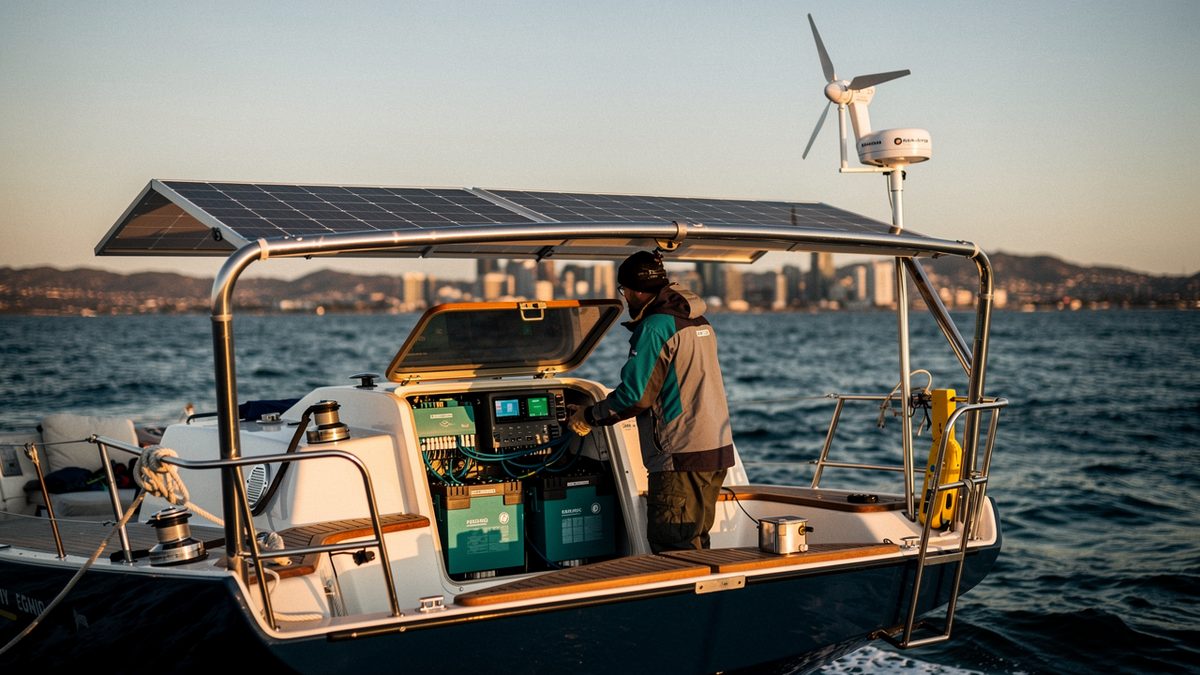
Yes, and it is one of the best ways to extend range. Solar and wind recharge the bank while you are underway or at anchor. See solar and wind power for boats.
Batteries, Solar & Wind Power
Battery banks, lithium upgrades, battery management systems, shore chargers and marine solar and wind installations.
How long do marine lead-acid batteries last?
Expect about three years of gradually declining health before replacement. We install and service lead-acid batteries every day, as well as lithium systems. See marine batteries.
Should I upgrade my boat to lithium batteries?
Lithium delivers more usable power, holds voltage under load and pairs well with solar, but it costs more up front and must be matched with the right charging and battery management. We will size a bank for how you actually use the boat. Ask us about a battery upgrade.
What is a battery management system (BMS)?
A BMS monitors and protects a battery bank. It optimizes performance, extends lifespan, keeps charging safe and gives you real-time data on battery health and efficiency. Every lithium installation should have one.
Do you install shore power chargers and inverters?
Yes. Shoreline charging systems have been a core part of our work since 1986, along with inverters, alternators and complete charging systems.
Can solar panels be installed on a boat?
Yes, but boats are not rooftops. Arrays must survive wind loads, motion and salt, so the structure matters as much as the panels. We have built very large arrays on sailboat arches and hardtops. Even one panel can noticeably cut generator fuel use. See solar and wind power.
What voltage should a marine solar system use?
Marine solar runs at 12, 24 or 48 volts on most boats and at much higher voltages on large systems. Panels in series raise voltage and in parallel raise current. Any DC system above 48 VDC is serious work, and above 120 VDC an electrical engineer should be involved.
Is wind power worth adding to a boat?
For boats that spend time at anchor or cruise in windy areas, a wind generator combined with solar reduces generator run time and keeps batteries topped up overnight. We design both into one charging system. See our cruising sailboat outfitting.
Boat Electrical Systems
Panels and breakers, engine electrical, lighting, alarms, and stopping corrosion and electrolysis before it eats your running gear.
Do you build custom breaker panels and dash controls?
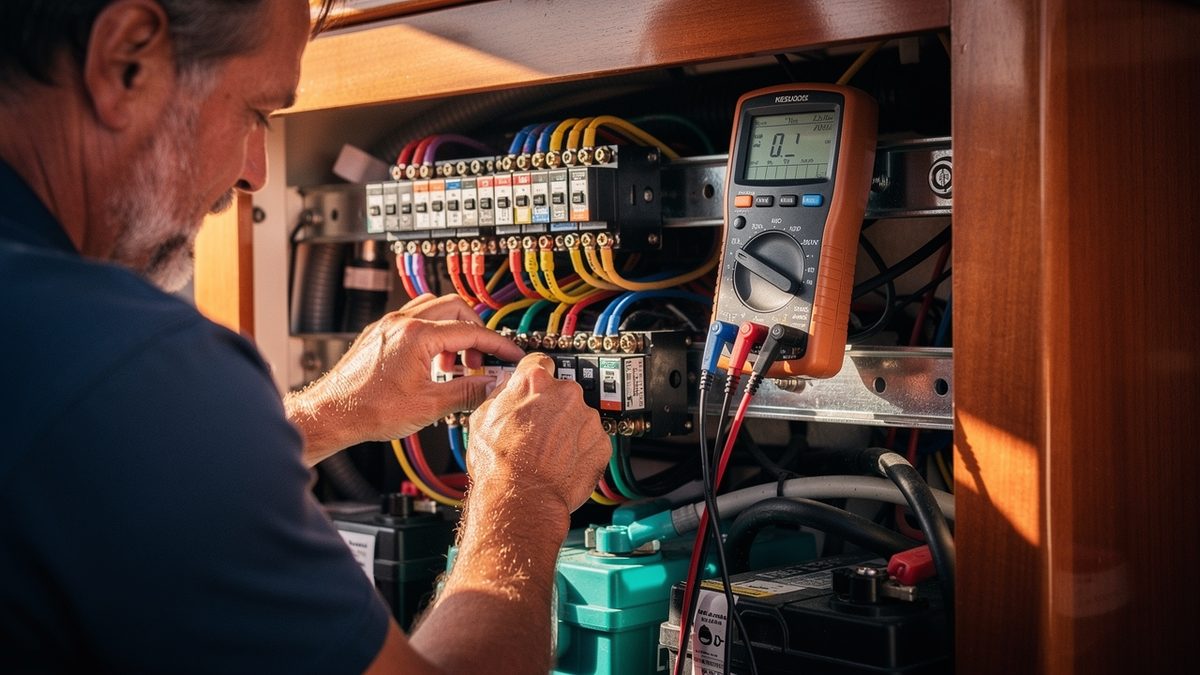
Yes. Greg Moore has designed custom breaker, switch, control and alarm panels since the late 1980s, including complete electrical systems for 80- and 90-foot yachts. See panels, breakers and dash controls.
What causes corrosion and electrolysis on a boat?
Electrolysis is corrosion driven by stray electrical current, usually DC, flowing through submerged metal in seawater. It is far more destructive than ordinary galvanic corrosion and can destroy chains, thru-hulls, rudders and shafts in less than a week. See corrosion and electrolysis.
How do I stop stray current corrosion?
The boat must be wired correctly and outside sources of stray current identified. Install a potential meter where you can see it. If it is pegged, switch DC breakers off one at a time until it drops to find the circuit at fault. Then call us to correct the wiring.
Should my boat's underwater metals be bonded?
It depends on the boat. A proper bonding system lets you monitor and protect everything, but if everything is tied together and a stray current reaches it, the whole system can be damaged. The right answer comes from testing your boat, not a rule of thumb. Learn more on corrosion and lightning suppression.
Do you repair engine electrical systems?
Yes: harnesses, charging, sensors, alarms, electronic throttles and shifters, ECM/ECU programming, fuel level and safety systems, and NMEA 2000 engine data. Greg has also rebuilt dozens of large marine engines, including Cummins, MTU, MAN and Mercedes. See engine electrical.
Why do my LED lights interfere with my radio or GPS?
Many LED dimmers and drivers produce electronic noise. We install low-noise dimmers that reduce hum and interference with VHF, satellite and GPS signals, and we can make every light on board switch to red for night vision. See interior and exterior lighting.
How many bilge alarms does my boat need?
At least two high-water bilge alarms, with visual indicators at the helm. We also integrate alarms for fire, smoke, low voltage, tank level, ground fault, corrosion, bait flow and anchor watch into custom panels. See alarms and level gauges.
Navigation, Electronics & Communications
Radar, multifunction glass-bridge displays, sonar, autopilots, satellite communications and fishing electronics.
What kind of radar should I buy for my boat?
For most boats, choose an X-band radar with the largest open-array antenna you can fit and afford. Choose a dome if a rotating antenna could snag a sail or space is tight. Larger radars run on 24 V or more, and S-band performs better offshore in heavy rain and seas. See radar and our radar antennas and theory guide.
Can you repair an older autopilot?
Yes. We do component-level autopilot repair on Benmar, Sperry, Wesmar, Robertson, Simrad, Raymarine, Garmin, ComNav, Cetrek, Navico and W-H units, including decades-old systems. We also fix hydraulic and mechanical steering, because an autopilot cannot work on a poor steering system. See autopilot install and repair.
What autopilot and heading sensor do you recommend?
Furuno is our favorite autopilot for cruisers and sportfishers alike, and every autopilot benefits from a satellite compass such as the Furuno SC30. See autosteering.
Do you install multifunction glass-bridge displays?
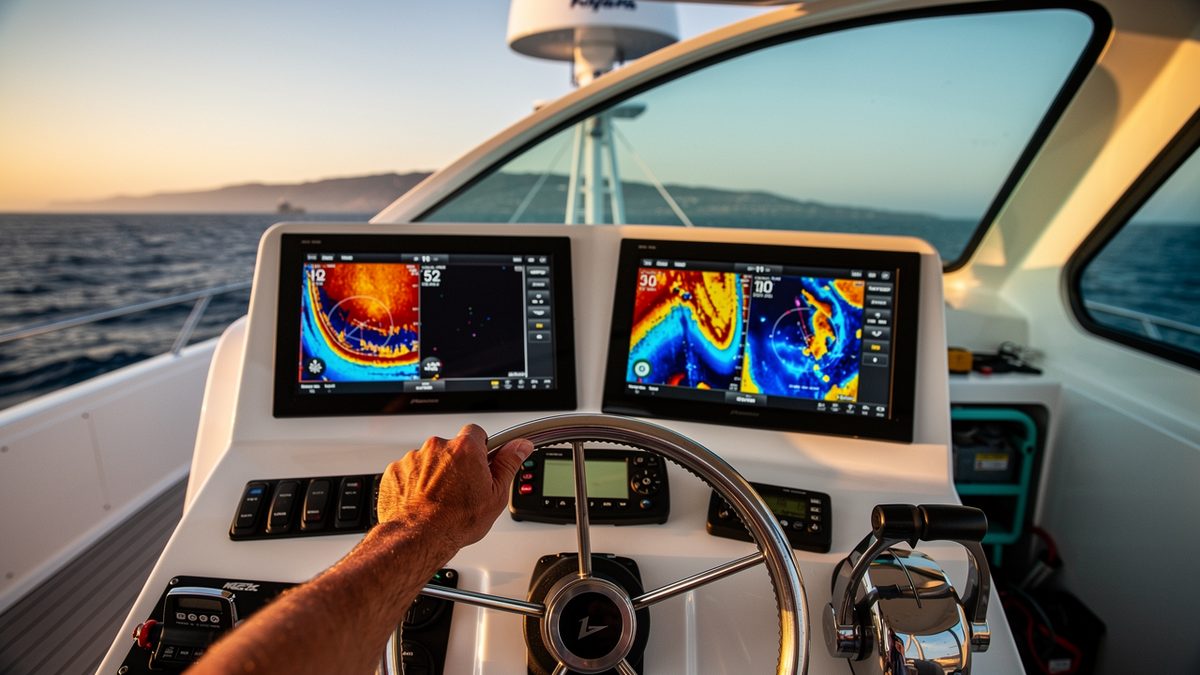
Yes. We design and network multifunction touchscreen displays with radar, sonar, charts and sensors for everything from tenders to Navy ships. See multifunction displays, and our 2026 marine electronics buyers guide.
Do you install and service omnidirectional sonar?
Yes. Greg Moore trained at Navy sonar school in 1977 and has since helped hundreds of full-sector-scan users. We install Furuno Omni sonar with a hull technician, electrician, electronics technician and engineer involved. See Omni sonar and fishfinder school.
Can I get internet and TV on my boat?
Yes. We install satellite, cellular and Wi-Fi systems and configure hybrid networks so you stay connected in the marina, along the coast and offshore. Greg installed San Diego's first DirecTV satellite system in 1997. See satellite communications.
What fishing electronics do you install?
Sea surface and water temperature sensors, bait flow alarms, bait plumbing and pump selection, deck, flood, cockpit and squid lighting, plus sonar and fishfinders. See fishing systems.
Navy, Commercial & Engineering
Government and commercial vessel contracts, Coast Guard inspections, new-build electrical design and industrial electronics.
Can you help my vessel pass a Coast Guard inspection?
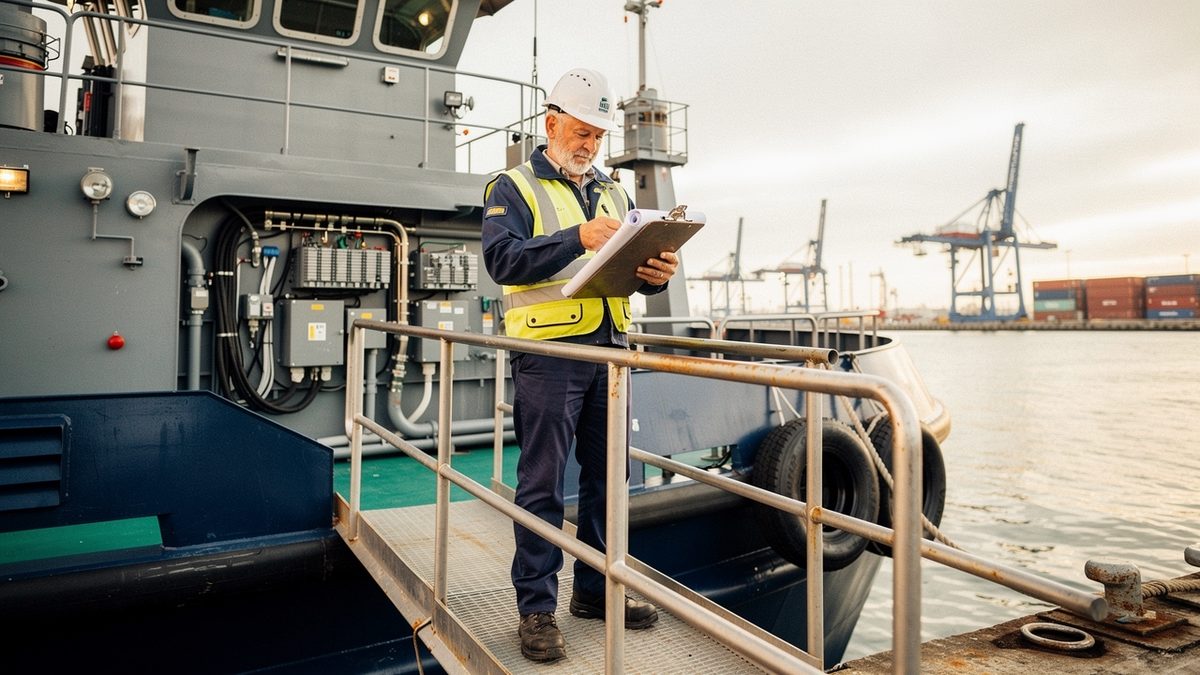
Yes. U.S. Coast Guard Subchapter T work and electrical schematics are routine for us, and helping commercial passenger vessels pass inspection is a specialty. See commercial vessel services.
Will you bid on our repair contract or solicitation?
Yes, we bid on Navy, commercial and merchant ship repair contracts. We do not monitor solicitations, so please contact us or call to alert us when one opens.
Do you design electrical systems for new boat builds?
Yes. Greg designed complete electrical systems for custom yachts in the 1980s that are still cruising 40 years later. We design engine rooms, lighting, navigation and full electrical systems for builders and owners. See electrical engineering.
Do you work on land-based or industrial electronics?
Yes: land-based radar, entry and access systems, cameras and security. Our underwater cables at SeaWorld have survived about 30 years of dolphins chewing on them. See industrial electronics.
Dockside Service & Pricing
What dockside service costs, how billing works, and how to keep your bill down when a technician comes to your slip.
How much does dockside marine electrical service cost?
Our published dockside rate is $3 per minute ($180 per hour), with a $500 minimum to visit a boat that covers the first three hours. Time after that is billed at $180 per hour, plus parts. See dockside service cost for the current rate.
Why is there a minimum charge to come to my boat?
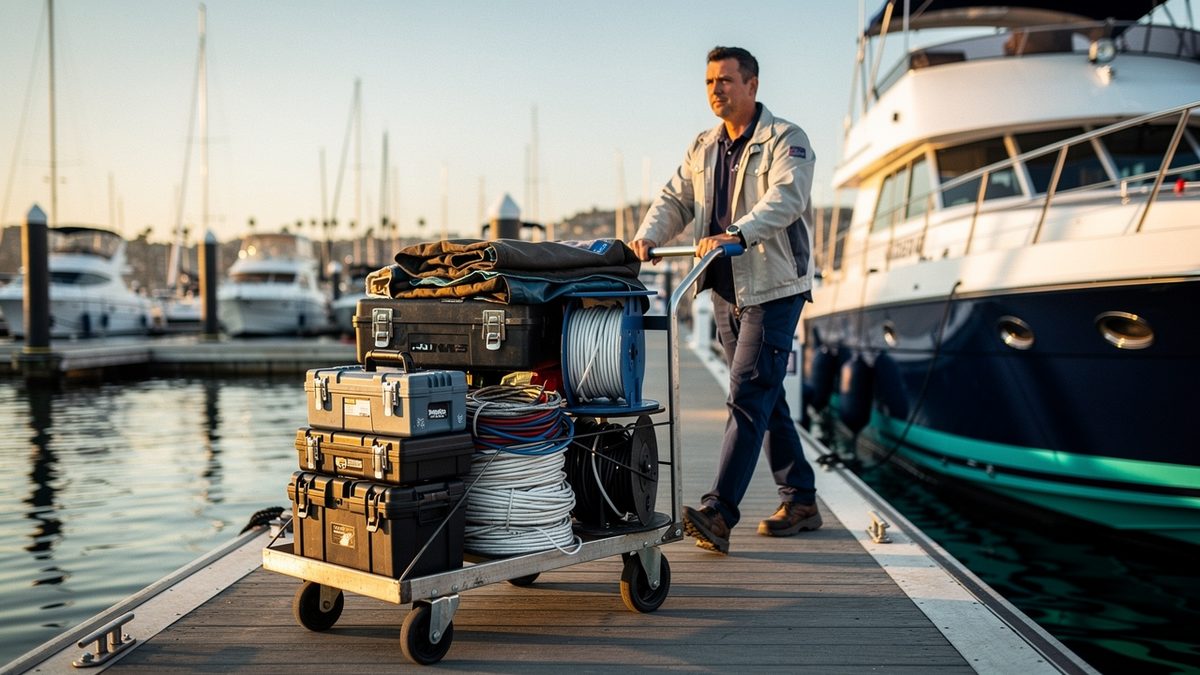
Marina work eats time before any repair starts: getting keys, hauling fully loaded dock carts down the ramp (hard at low tide), covering and protecting your boat, and cleaning up each day. A marina visit typically takes half the day.
Can you give me a fixed-price quote?
Most repairs are too complex to bid at a fixed price, because it takes an unpredictable amount of time to find and fix the real problem. Cost usually becomes predictable about halfway through a job, and we never add work or charges without your input.
Is it cheaper to bring my boat to your boatyard?
Usually, yes. If you have a lot of work, doing it all at once or bringing the boat to our yard costs far less than repeated marina visits. Ask us which option fits your project.
How can I keep my dockside repair bill down?
Give the technician your marina and boat keys, meet them on the boat, and walk through the whole job and your expectations. Designate one decision-maker for the boat. On multi-day jobs, a safe place to leave tools aboard avoids about $100 a day in pack-up time.
What happens if you find other problems on my boat?
We text you a report whenever we find pre-existing damage, with a repair suggestion, so you decide what gets done. We also protect your boat with coverings while we work.
Do you offer emergency marine electrical service?
Yes, when it is possible. Our schedule is usually full, so emergency work means pulling a crew off another job and carries concierge fees. Call (619) 218-1018.